Accounting
The Accounting mechanism is one of the core application-level mechanisms of the platform. It enables the implementation of double-entry bookkeeping within an application. Well-suited for diverse business environments, it does not impose specific accounting principles, allowing developers to create accounting models applicable in Russia and other countries.
The Accounting mechanism offers the following key capabilities:
- Managing multi-level charts of accounts with arbitrary hierarchies, supporting account codes of both fixed and variable length;
- Performing analytical accounting across multiple dimensions and levels;
- Simultaneous accounting using multiple charts of accounts;
- Maintaining consolidated accounting for multiple legal entities;
- Supporting various accounting types (including quantity-based and currency-based accounting) for specific analytical dimensions.
Accounting in 1C:Enterprise is implemented through three configuration objects: the Chart of Accounts, the Chart of Characteristic Types, and the Accounting Register:
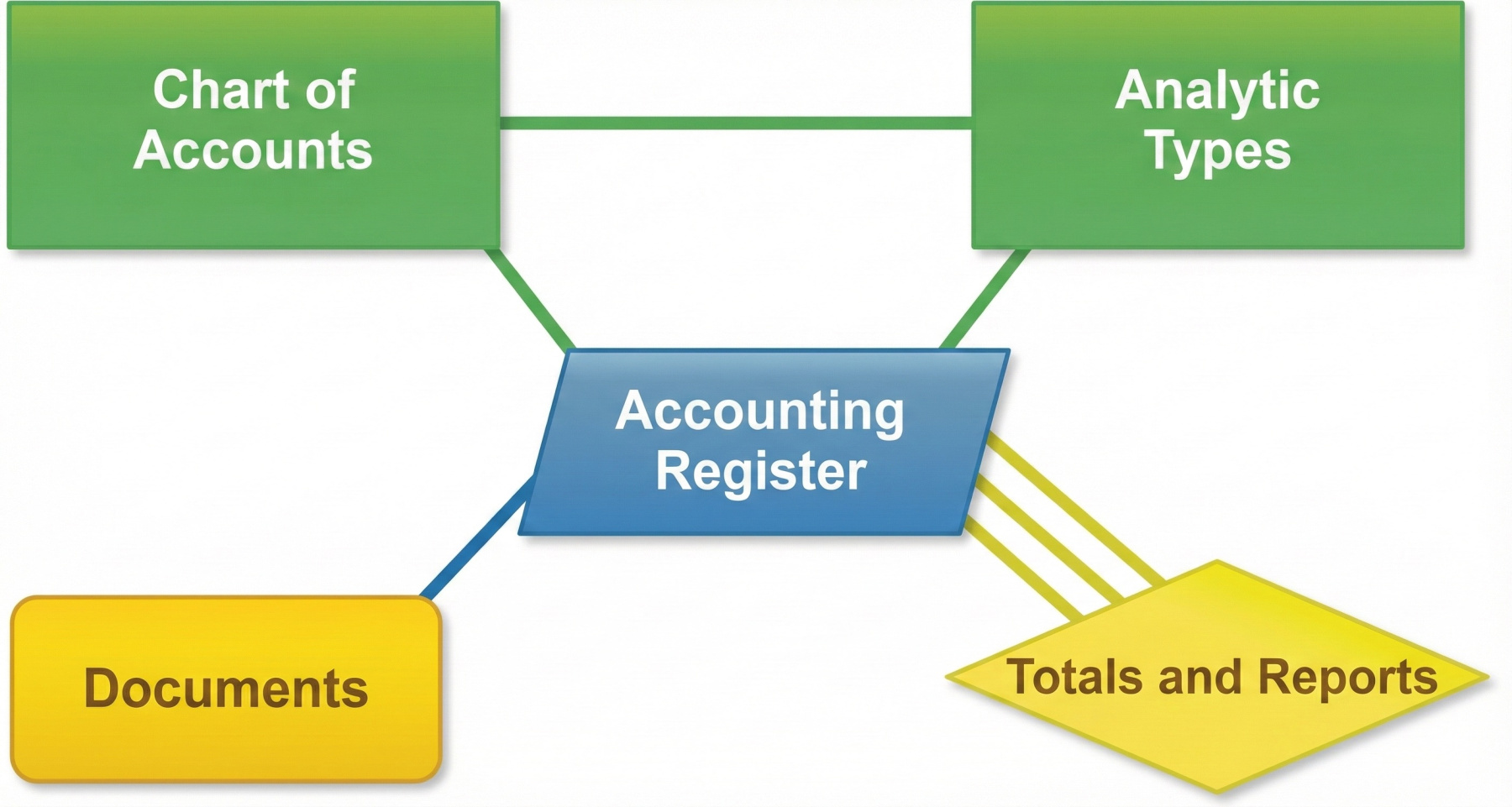
- Chart of Accounts
Defines the set of synthetic accounts used to group information about the enterprise's business operations. By defining the Chart of Accounts, you establish the required accounting system. An application can contain as many charts of accounts as necessary. Read more…
- Chart of Characteristic Types
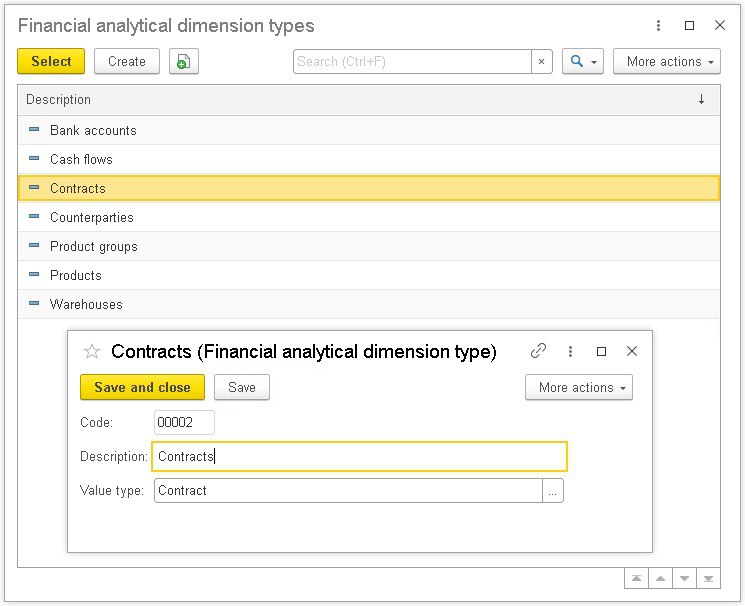
Describes the analytical accounting objects (subconto) tracked on specific accounts. It defines both the subconto types and the specific value types that each subconto can accept:
- Accounting Register
Records information about business transactions in the 1C:Enterprise system and retrieves summarized accounting data. The Accounting Register connects to a specific Chart of Accounts and stores accounting totals according to its structure. Read more…