Rapidly Build Robust Business Applications Without Compromising Flexibility
1C:Enterprise is a cloud and on-premises system for automating financial and operational activities. It supports a wide range of business needs and adapts as those needs change. Its key strength is configurability, which lets companies shape the system around their own processes.
Rather than enforcing fixed business rules, it provides a software toolkit used by both developers and business users. At the core are two closely connected components: the platform and the application that runs on it.
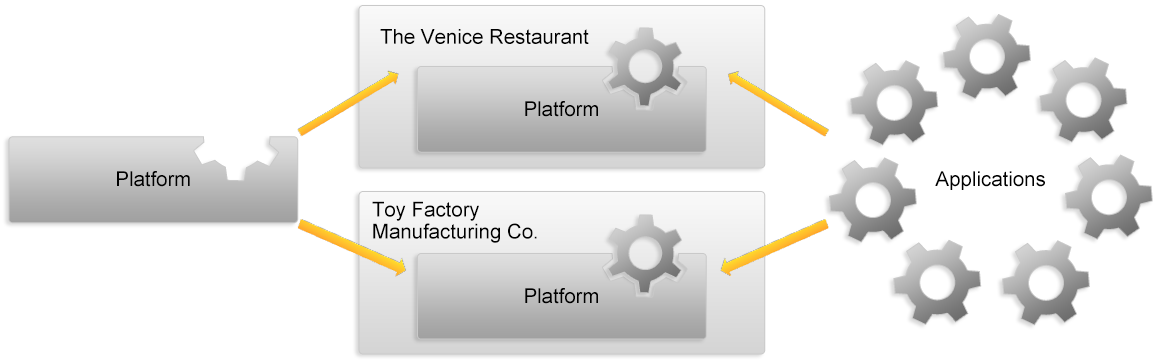
Understanding the Architecture: A Creator Platform Analogy
To explain how these components work together, compare 1C:Enterprise to a content platform like TikTok or YouTube.
These platforms are popular because they provide a powerful studio with ready-to-use tools. You get filters, effects, media libraries, and video processing capabilities out of the box, so you can focus on creating content instead of building rendering technology.
- Platform acts as the studio and engine. It provides the technical foundation, including runtime environment, interface tools, database connectors, and logic builders.
- Application (configuration) acts as the content. It is the specific business solution you build with the platform tools.
On TikTok, the Create button is useless without your idea and input, and your idea cannot become a published video without platform tools.
In 1C:Enterprise, the platform plays that same role. It lets you create and run applications quickly. There is one platform, but you can build an unlimited number of applications. Every application depends on the platform to run. The platform itself does not automate business tasks; it provides the development and runtime environment.
1C:Enterprise Platform Offers the Following Advantages
- Reduces technical complexity and helps address usability and performance challenges in enterprise software.
- Enables power users to implement business-specific processes.
- Speeds up and standardizes development, customization, and support.
- Provides full visibility into UI and solution code for easier understanding and change control.
- Integrates with existing 1C applications and third-party systems.
- Supports web services, ODBC, COM, and other integration options.
- Supports major deployment architectures, including Windows/Linux and MS SQL, PostgreSQL, IBM DB2, and Oracle DB.
- Supports on-premises and managed hosting, with client access via web, tablet, and Windows applications.
The 1C:Enterprise Ecosystem
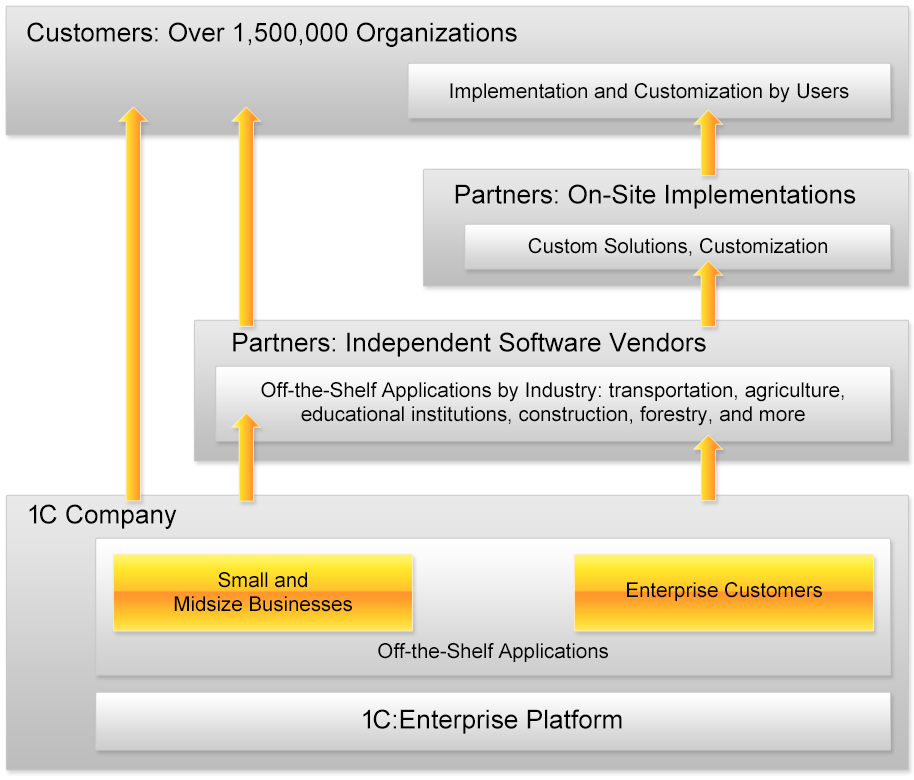
The 1C:Enterprise application system is used daily by several million users across business and government. It helps automate core workflows in operations, accounting, finance, HR, and management while giving teams the flexibility to adapt processes as requirements evolve. 1C Company provides a broad set of vertical solutions for manufacturing, distribution, and service organizations, making it practical in both standard and industry-specific scenarios. With an open architecture and fast update cycles, the system scales reliably from single-user deployments to environments with hundreds of users.
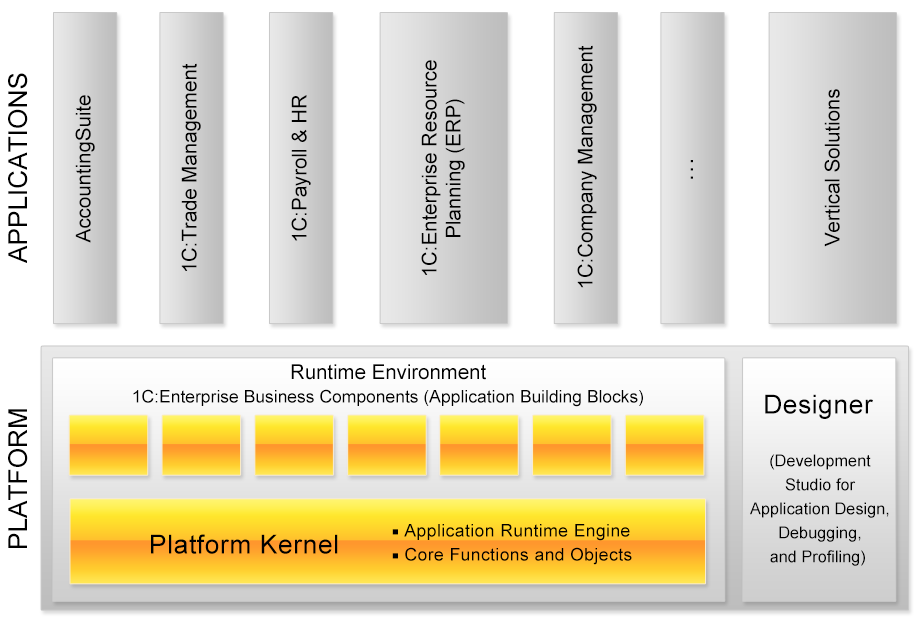
1C:Enterprise includes the platform and applied solutions (off-the-shelf applications).
The relationship between the platform and applied solutions is straightforward: one core platform supports many applied solutions, and 1C Company with its partners continues to introduce new ones.
This architecture lets teams work at a higher level and focus on business logic instead of low-level technical details. The platform handles low-level tasks such as data access, system performance, and user interface behavior.
1C:Enterprise Allows You to Do the Following
- Adapt the system to match the business terminology used by end users and subject matter experts.
- Speed up and standardize development, implementation, customization, and maintenance of applied solutions.
- Let customers review applied-solution algorithms and modify them when needed.
1C:Enterprise Platform Consists of the Following Parts
- Data/process layer provides core system features, including support for multiple databases, application server functions, web server components, and web services components.
- Business components are predefined, visually configurable building blocks used in enterprise applications. They include catalogs, documents, accumulation registers, bookkeeping engine, calculation engine, and business process engine.
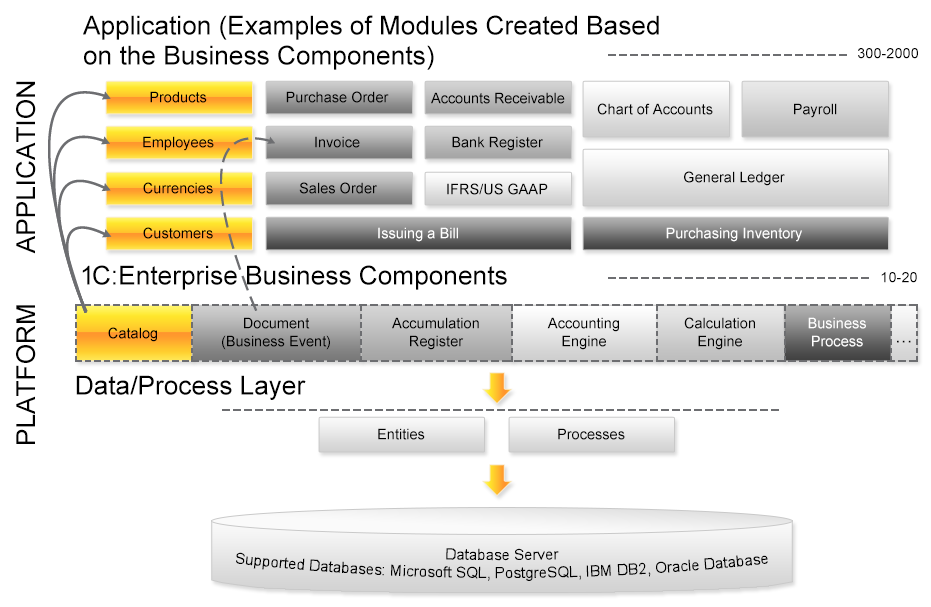
The diagram above shows how core business components are used in a typical business application:
- Catalogs store reference data such as customers and products.
- Documents capture business events such as purchase orders, sales orders, and invoices.
- Accumulation Registers store posting transactions, for example accounts receivable and bank activity.
- Accounting Engine records accounting postings for both specialized ledgers and the general ledger.
- Calculation Engine performs payroll and related calculations.
- Business Processes orchestrate workflows across the system.
Using business components can significantly reduce development costs because teams can focus on company-specific processes instead of rebuilding common functionality from scratch.
The diagram below shows the full 1C solution architecture, including the platform and applications.
- Platform consists of the application server, business components (visually configurable building blocks), and IDE environment.
- Business applications running on the platform include solutions from 1C Company for small and midsize businesses, such as 1C:AccountingSuite, and for enterprise customers, such as 1C:ERP World Edition, 1C:Trade Management, 1C:Document Management, and 1C:Analytics. The 1C partner network also offers vertical solutions for many industries.
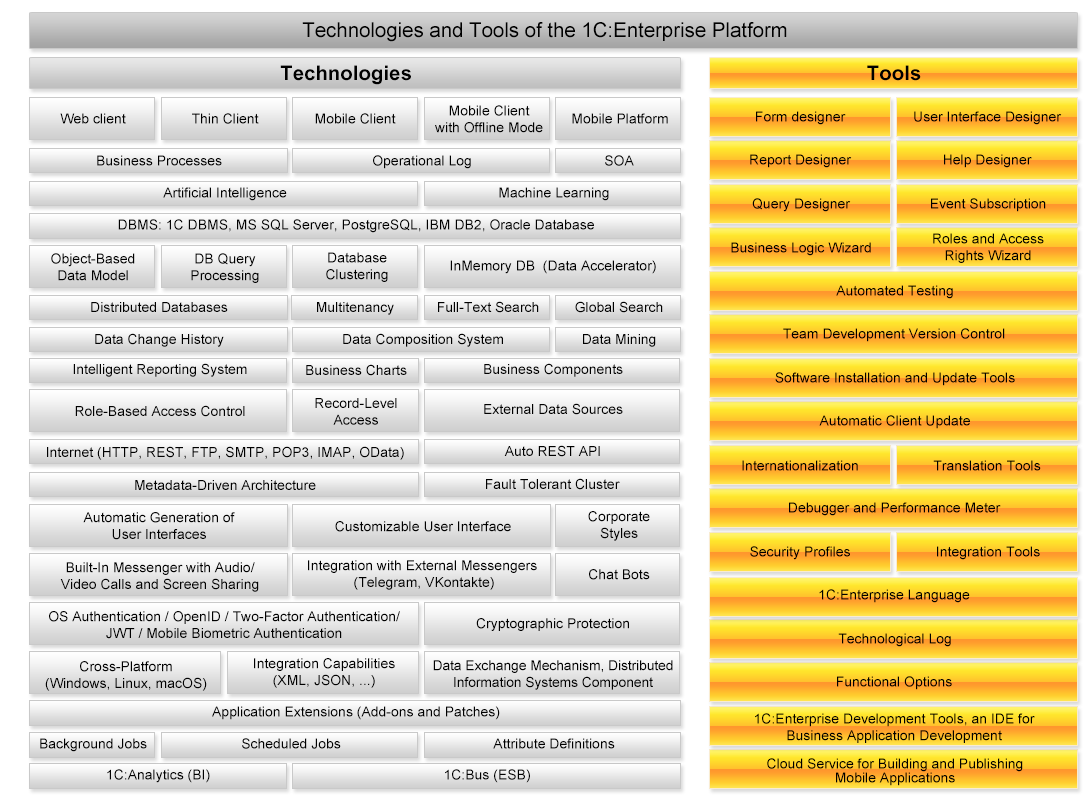
The following table summarizes technologies and tools included in 1C:Enterprise.
Next page: Getting started